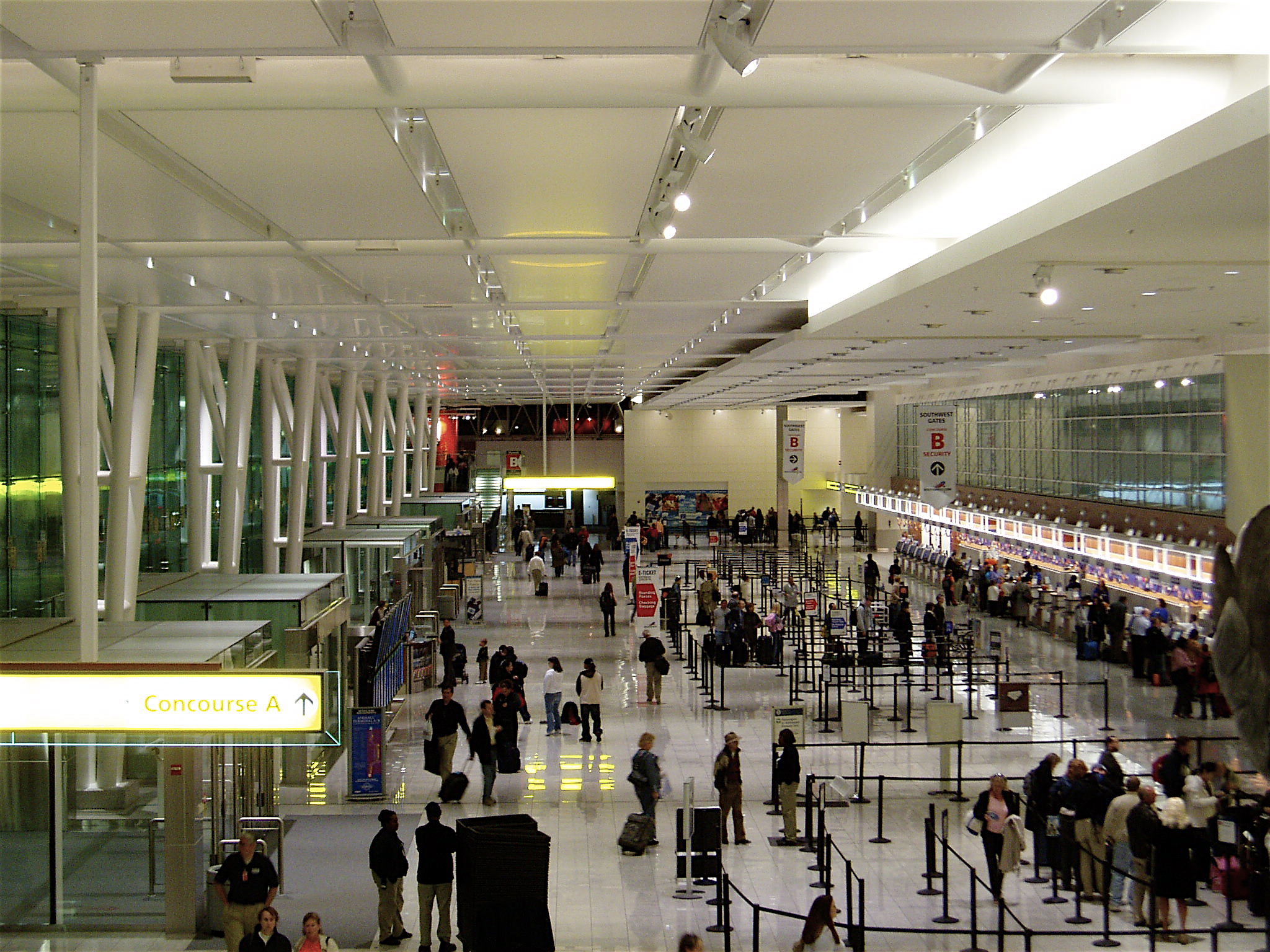
The plane lands at 10:47 PM. You drag your bag to level four of the BWI Daily Garage, pop the trunk lid, and realize the fob isn’t in your jacket. It isn’t in the side pocket of your carry-on either. You’re locked out of your car at BWI, your phone is on 12 percent, and the garage gets quieter by the minute.
Airport lockouts happen a few times a week to somebody in our part of Maryland. Same story at Reagan National. We get the calls. We also see the same five or six mistakes repeated almost every time, and most of them cost people an extra hour or two when the fix could have been faster.
Here is what to do, in the order it actually helps.
Why airport lockouts are their own kind of problem
A driveway lockout is annoying. An airport lockout is annoying with a specific stack of complications layered on top.
You are tired. You’ve been moving since before dawn, and decision-making is the first thing that goes when you’re running on three hours of sleep and airport food. You’re often in a multi-level garage where cell reception is patchy and you can’t pin your location with GPS. The hour is usually wrong, somewhere between 9 PM and 1 AM, when most people would be home for the night. Your spare key, if you have one, is twenty miles away at the house you just spent a week away from. And if you flew with a checked bag, there’s a real chance your key is sitting on top of a sock somewhere inside it.
That’s the actual problem we’re solving. Not “open a locked door,” which is the easy part. The hard part is everything around it.
The first ten minutes: do these before you call anyone
Most lockouts that turn out not to be lockouts get resolved here. Don’t skip it.
- Check every pocket on your body twice. Jacket inside pocket, pants back pockets, jacket outside pockets. People miss the same pocket on the first pass because they’re looking with their hands instead of their eyes.
- Open the carry-on. Side pockets first, then the main compartment. Keys migrate during flights, especially if you took the bag out of an overhead bin.
- If you checked a bag, accept the possibility right now that the key may be in it. Sit down for a second. Picture yourself packing the morning you left. Did you toss the key in for “safekeeping”? If yes, you’re not locked out, you have a checked-bag problem, and the answer is different.
- Look through the driver-side window before assuming the key isn’t in the car. Drivers lock keys inside more often than they lock keys outside.
- Walk back to the curb if you remember dropping anything when loading bags. Keys end up in the bin you tossed your coffee cup into more often than anyone admits.
If after five minutes of that you still don’t have the key in your hand, call.
When a locksmith is the right call, and when it isn’t
A locksmith fixes a few situations at the airport with no fuss:
- You know exactly where your key is, and it’s somewhere you can’t reach (locked in the trunk, locked in the cabin, sitting in the checked bag carousel two terminals away).
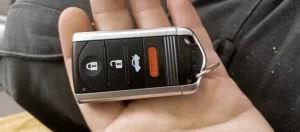
- Your key fob died and the door won’t respond. Modern fobs can fail in cold parking garages after a week sitting in a cold lot, and the mechanical backup key tucked inside the fob is what you actually need.
- You lost the key entirely, and there’s no spare within an hour. We can cut and program a replacement on site for most makes.
A locksmith is not the right call if your only key is genuinely at your house thirty miles away and a friend or family member can drive it to you in less time. We will tell you that on the phone. We don’t talk people into a service call they don’t need.
A locksmith is also not the right call for the situation where you’ve just learned, with terrible clarity, that the key flew home in your checked bag. In that case the right answer is usually to get a ride home, retrieve the key, and come back. We can sometimes still help, depending on the car and what the replacement key involves, but it’s a longer conversation.
What to have ready when you call
Locksmith dispatch goes faster when the first ninety seconds of the call aren’t spent untangling basics. Have these answers before you dial:
- Exact location: not “BWI parking,” but “Daily Garage, level 4, near elevator C, blue Honda CR-V.” For Reagan, the garages are A, B, and C, and the level matters. We’ve been sent to the wrong garage at both airports more times than we can count.
- Year, make, model, and trim of the car. The difference between a 2018 Toyota Camry LE and a 2018 Camry XLE is the difference between a metal key and a smart key.
- Type of key. Basic metal? Transponder (a chip key with a slightly bulky head)? Smart fob with push-to-start? You don’t need to know the technical term, just describe what your normal key looks like.
- Whether you have proof of ownership on you. Registration, insurance card, or a digital photo of either works. We won’t open a car for someone who can’t show it belongs to them, and good locksmiths in Maryland and DC don’t either. That rule is non-negotiable for everyone’s protection.
Have that ready, and the call takes about three minutes. Without it, dispatch is twenty questions.
Push-to-start cars and dead fobs
This is the single most common airport lockout we see, and it surprises people because they don’t think of a dead fob as a lockout. The car is “fine.” The key is in their pocket. The button on the door handle just doesn’t do anything.
What’s happening: the fob’s coin battery has died. Most modern fobs have a hidden mechanical key inside the fob body that pops out via a small release. That mechanical key opens the driver’s door manually. Once you’re in, you can start most push-to-start cars by holding the fob directly against the start button, which uses the unpowered fob’s chip via inductive contact.
If you’ve never done either of those things, it’s worth ten minutes on YouTube before your next trip. If you’re already in the situation, that’s what we walk people through on the phone before we even leave the shop. A good portion of the calls we get from BWI between November and February end with us saying “you’re already in, you don’t need us, drive carefully.” That’s a good outcome.
After you’re back in the car
Two things to do in the next forty-eight hours, while it’s still fresh.
Replace the fob battery. They’re widely available at any hardware store, take two minutes to swap, and prevent the next instance of this same problem.
A spare key tucked somewhere that isn’t your normal keychain. We mean a real backup, not a “I’ll get to it eventually” reminder on your phone. For families that travel a lot, getting a spare key duplicated and programmed is one of the smarter things you can do for your future self. We do it routinely for customers across Maryland and DC, from Silver Spring to Capitol Hill.
FAQ
Can airport security or police help me get into my car?
Sometimes, but it’s the wrong tool for most modern cars. Airport police at both BWI and Reagan will usually only assist with older vehicles where a slim jim works without damaging the lock or the door’s electronics. For anything from roughly the last fifteen years, they refer out to a locksmith. Worth asking, not worth waiting on.
Do you handle Reagan National even though it’s in Virginia?
We serve Maryland and DC, and Reagan sits right at the DC border. We get there regularly. Call and tell us where the car is. If something is genuinely outside our coverage, we’ll say so on the phone instead of letting you sit and wait.
What if I lost the key entirely and don’t have a spare?
We can cut and program a new key on site for most cars made in the last twenty years. We carry the equipment in the van. Bring proof of ownership and the year, make, and model. The process at the car varies a lot depending on whether programming is required and how many keys the system already has registered.
If you’re stuck right now
Walk back through the checklist above first. If the key isn’t on your person, isn’t in your carry-on, and isn’t visible inside the car, and you’re parked at BWI or Reagan National, we can almost certainly get you out of the garage tonight.
Call (301) 888-5152 and a real person will pick up. Tell them the airport, the garage, the level, and the car. If you’d rather not call, request a quote through our contact form and we’ll get back to you.