Most lock failures in Maryland happen in February and August. Same hardware, different reasons. Both are predictable, and most are preventable.
If you live anywhere from Annapolis to Frederick, your front door spends the year cycling through humid Chesapeake summers, road salt, freezing snaps, and the temperature swings of March and October. Every phase does something specific to the metal and the moving parts inside your locks. Most homeowners only notice when the key suddenly won’t turn at 7am.
Here’s what’s actually happening to your hardware, and what to do about it before you’re standing outside your own house.
Humidity: the slow kind of damage
July and August in this region are wet. Even when it’s not raining, the air carries enough moisture that brass and pot-metal lock components start to corrode at the surface. Older brass deadbolts resist this fairly well. The cheaper pot-metal hardware that ships with most builder-grade exterior doors does not. In waterfront neighborhoods close to the Bay (Annapolis, Eastport, the stretches of Kent Island closest to the water), salt air accelerates everything. Inland, in places like Rockville or Frederick, it’s slower. It still happens.
What you’ll notice first is a key that turns with a little more drag than it used to. Then a lock that needs a wiggle. Then one day the key turns but the bolt doesn’t retract cleanly.
There’s also the door itself. Wood doors in older row houses in Capitol Hill or Georgetown swell with humidity. The lock mechanism is fine. The door has shifted enough that the bolt no longer aligns with the strike plate. Same symptom (sticky lock), totally different cause. If your door rubs the frame in summer but not in winter, that’s the tell.
The fix here isn’t aggressive. Don’t spray WD-40 into the keyway. It cuts dirt loose, then dries to a film that holds new dirt against the pins. We’ll come back to this.
Freezing temps: the fast kind of damage
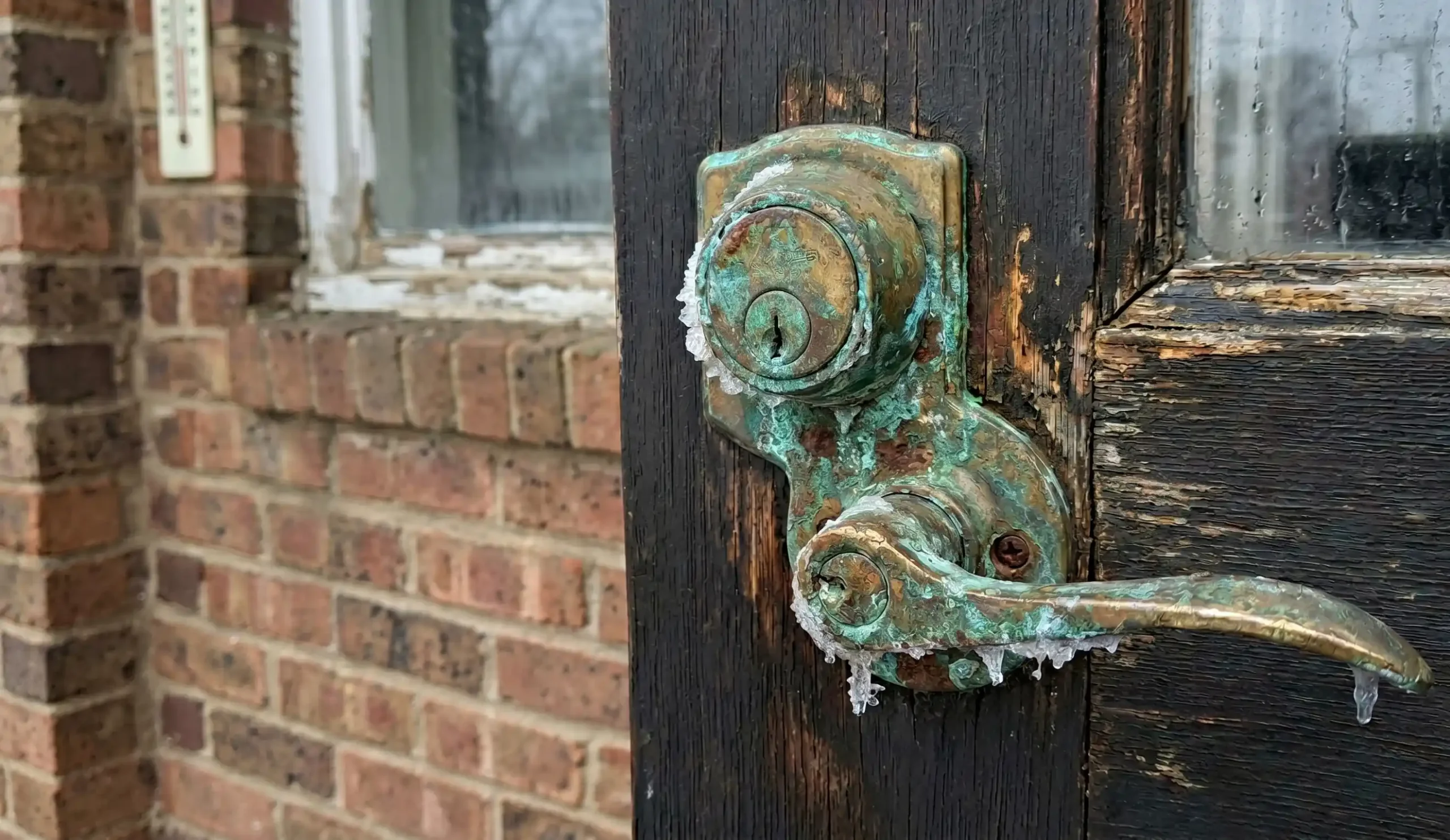
January and February work the opposite angle. Metal contracts. Lubricants thicken. Whatever moisture made it into the cylinder during a wet December freezes into a film that locks the pins in place.
If you’ve ever had a key that turns halfway and stops on a 20-degree morning, that’s usually water in the cylinder, not a broken lock. Pour warm (not hot) water over the keyway from a thermos, or use a hair dryer on low. Don’t force the key. A snapped key inside a frozen cylinder is the most common emergency call we get in February, and the original lock almost always survives the cold just fine. The repair cost comes from the extraction.
Door knobs and lever handles freeze differently from deadbolts. Knob mechanisms have more moving parts and tighter tolerances, so the same moisture that just stiffens a deadbolt can lock a knob completely. If you have a side or back door with only a knob lock, that’s the one likely to fail first on a cold morning.
Smart locks have their own freezing problem. Most use AA or lithium-ion batteries, and lithium loses meaningful capacity below freezing. A keypad lock that worked all fall can suddenly read “low battery” the first week of January, then refuse to fire the bolt entirely on the coldest morning. If you have a smart lock on a north-facing or unprotected door (think exposed front doors in Bowie or Gaithersburg without a porch), replace batteries in November regardless of what the indicator says.
There’s also road salt. Cars track it onto stoops, snow blowers throw it onto porches, and any deadbolt or knob within knee height takes the spray. Salt plus moisture is the most corrosive thing your lock will see all year. Wipe down exterior hardware twice during winter with a damp cloth, then dry it. That’s the whole maintenance step.
The transition months no one warns you about
March and October produce the strangest lock calls. The hardware isn’t damaged by either extreme. It gets damaged by the swing between them.
A wood door that swelled all summer slowly shrinks as fall comes in. The strike plate alignment that was tight in August is suddenly loose in October, and the bolt has slop. Then in March, the door starts swelling again on the first humid week, and the lock that worked fine all winter gets sticky.
A sticky door isn’t always a wood-door problem. Steel and fiberglass doors expand less, but the weatherstripping around them swells and compresses through the seasons. If the lock works fine but the door fights you when you close it, the strip is doing what the wood used to do.
Older homes feel all of this more. A 1940s brick rowhouse in Hampden or a 1920s craftsman in Takoma Park has door frames that have moved across decades, and the original mortise hardware was installed when the door fit one way. New construction in places like Clarksburg moves less, but the hollow-core interior doors and basic-grade exterior locks have less margin for any movement at all.
If you find yourself adjusting the door pull every few months to get the deadbolt to seat, the door isn’t the problem. The strike plate needs to move or the hinges need to be shimmed. We do this work regularly, and it’s usually a quick adjustment rather than a hardware replacement.
What to actually do (without ruining your locks)
Most weather-related lock failures are slow. You get warning signs for weeks before the lock actually quits. The fast, cheap moves that prevent the emergency call:
- Use the right lubricant. Graphite powder or a dry PTFE-based spray. Not WD-40 or 3-in-1 oil. Both leave residue that traps grit against the pins. Two short bursts into the keyway once a year is plenty.
- Lubricate the bolt and the strike, not just the keyway. The bolt sliding into the strike plate is where most “sticky” feel actually comes from.
- Check exterior hardware after the first hard freeze and after the first humid week of spring. Look for crusted residue or green corrosion at the screws. A door that’s started to scrape the frame also points to weather movement.
- Tighten the screws on your strike plates and hinges once a year. Loose hardware shifts under temperature swings and creates alignment problems out of nothing.
- For smart locks: pre-empt the cold. Fresh batteries before Thanksgiving. Lithium AAs handle cold meaningfully better than alkaline if your unit supports them.
If the lock is already failing (key won’t turn or the bolt won’t retract), don’t keep forcing it. Forcing a stuck cylinder breaks pins inside the lock, and what should have been a basic repair turns into a full replacement plus a fresh key cut for every other lock you wanted to keep matched.
FAQ
Should I replace my locks if they’re sticky every summer?
Usually not. Most summer stickiness is door swelling or a lubrication issue, not a failing lock. Get the strike plate alignment checked first. Replacement only makes sense if the cylinder is internally corroded or the brand is so old that parts aren’t available.
Are smart locks a bad choice for Maryland winters?
No, but the cheaper ones struggle. Look for locks with documented cold-weather operating ranges, and replace batteries before the first freeze. Avoid models that depend only on a wifi or Bluetooth connection for entry. You want a physical keypad and a physical key override as backup.
My key works but the deadbolt won’t retract. What’s happening?
That’s almost always strike plate misalignment, not a broken lock. The bolt is hitting the edge of the strike instead of sliding into it. Open the door, then throw the deadbolt while the door is open. If it moves fine that way, the lock is fine and the alignment needs adjusting.
What about garage doors and side entries?
These take the worst weather exposure and get the least attention. Most homeowners check the front door because they use it daily. Side and garage entries quietly corrode for years, then jam at the worst possible moment. Give them the same lubrication and seasonal check you give your front door.
How often should exterior locks be replaced?
A well-maintained pin tumbler deadbolt typically lasts 10 to 20 years in this climate. Rekeying makes sense after a move, after losing a key, or when a roommate or contractor situation changes. Replace the whole lock when there’s visible corrosion or internal damage. A security upgrade is the other reason to replace rather than rekey.
When the slow problem becomes the fast problem
You’ll know it’s time to call when you’ve stopped trusting your front door. That moment usually arrives after a cold morning where you stood on the porch wiggling a key in your work clothes, or after the third time the deadbolt has refused to seat without a shove. The hardware was telling you for months. It’s just hard to listen to a door.
If you’ve reached that point with a lock anywhere in our Maryland and DC service area, Master Locksmith handles weather-related lock repair, rekeying, and replacement. Call (301) 888-5152 to talk to our team, or request a quote through our contact form and we’ll get back to you.