 By the Master Locksmith team · November 27, 2026
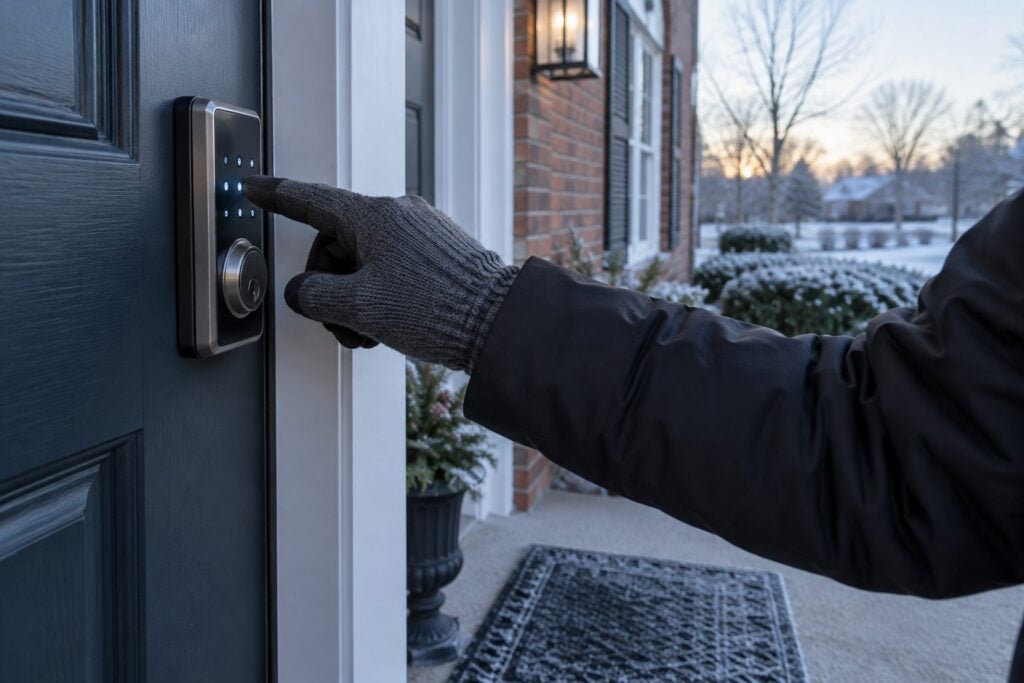
If your smart lock starts stalling halfway through a turn or flashing a low-battery warning once the mornings get cold, the lock itself is rarely broken. In most cases of smart lock cold weather trouble, the cause is one of two things: batteries that cannot deliver full power in the cold, or a deadbolt that has started rubbing against the door frame as the door shifts with the season. Both are easy to check, and both are worth sorting out before the first real cold snap.
FOX 5 DC’s winter outlook for 2026–27 calls for a milder, wetter winter than normal across the region, but even a mild winter around Silver Spring and DC brings stretches of below-freezing mornings. Those are the days a tired smart lock tends to give up.
Why batteries struggle in a cold smart lock
Many residential smart locks run on AA alkaline batteries mounted on the inside half of the lock, but the motor and keypad sit on or inside an exterior door that gets cold overnight. Battery chemistry slows down as the temperature drops. Energizer’s alkaline battery handbook explains that cold raises a battery’s internal resistance, so the cell cannot deliver its full power, even though no capacity is actually lost. Warm it back up and most of that power returns.
That matters for a smart lock because the motor needs a short burst of current every time it throws or retracts the bolt. A set of batteries that is half used can handle that burst at room temperature and fall short on a cold morning. The result is a lock that works fine in the afternoon and struggles at 7am.
Battery type matters too. Manufacturers specify the battery they have tested, and that is the one to use. Schlage’s support pages, for example, tell owners of its Encode series to use name-brand alkaline batteries and list lithium or low-quality batteries as a common cause of short battery life on those models. Check your own lock’s manual before switching types.
Signs the batteries are the problem
- The low-battery alert in the app or on the lock has appeared, even once.
- The motor sounds slower or weaker than it used to.
- The keypad lights dimly or takes a second to wake up.
- The lock works normally later in the day, once the door has warmed up.
Why the deadbolt may be the real problem
A smart lock’s motor is strong enough to move a bolt that slides cleanly, and not much more. When the bolt has to scrape past the edge of the strike plate, the motor stalls, the lock reports a jam, and the batteries drain faster because the motor keeps trying.
Doors move with the seasons. Wood doors and frames shrink as heated indoor air dries them out, and weatherstripping stiffens in the cold. On an older door that already sags on its hinges, that can be just enough to put the bolt out of line with the hole in the frame. On a manual deadbolt you would feel this as a key that needs a little extra push. On a smart lock, the motor feels it for you, and it does not push harder.
A quick test you can do yourself
- Open the door and lock it with the app or keypad while the door is open. If the bolt extends and retracts smoothly with the door open, the lock mechanism is fine.
- Close the door and try again. If it now stalls, jams or sounds strained, the bolt is binding on the strike plate or frame.
- Close the door and pull or push on it slightly while locking. If the lock suddenly works, alignment is the problem.
If the test points to alignment, the fix is usually an adjustment to the strike plate or the door’s hinges rather than a new lock. That is a job for a house lock repair visit, since forcing a lock to work against a misaligned frame wears out the motor.
What you can check before calling
- Replace all the batteries at once with fresh ones of the type your manufacturer recommends. Do not mix old and new.
- Check the Wi-Fi signal if your lock connects over Wi-Fi. Allegion’s support pages note that a weak signal makes the Encode lock keep searching and reconnecting, which drains the batteries faster. A router extender near the front door can help.
- Know your backup. Many smart locks have a physical key cylinder, and Schlage notes that some of its models have a jumpstart port for temporary power. Find out which yours has before you need it, and keep the key somewhere you can reach from outside.
- Look at the weatherstripping. If the door has to be pushed hard to latch, new or compressed weatherstripping may be holding it away from the frame.
- Turn on low-battery alerts in the lock’s app if they are off, and treat the first alert as the time to change batteries, not the third.
Do not spray household oil or grease into a smart lock. It collects grit and can foul the motor and sensors. If the bolt itself feels rough when you work the inside thumbturn, that is a sign the lock needs a professional look.
When a smart lock needs a locksmith
Some cold-weather smart lock problems go beyond batteries and settings. Call a locksmith when the bolt binds even after fresh batteries, when the door has visibly dropped or the gap around it has changed, when the lock was installed on a door that never lined up well, or when you are locked out and the backup key does not work.
A common root cause is the original installation: a smart lock fitted to a door whose strike plate was never adjusted for a motorized bolt. Our smart lock installation service covers that part of the job, so the bolt throws cleanly in every season. If you are still choosing a lock, our roundup of smart locks for DMV homeowners compares the popular models.
We are a mobile locksmith based in Silver Spring and serve homes across Montgomery County and the surrounding area, along with Prince George’s County and Washington, DC. Before a technician is dispatched, you get a clear quote and an honest ETA, and we explain the options first: adjust the strike and keep your current smart lock, or replace hardware that is past its best.
Smart lock cold weather questions
Will my smart lock stop working when it freezes?
Not usually. Cold reduces the power fresh batteries can deliver, but a lock with good batteries and a well-aligned bolt keeps working through a typical Maryland or DC winter. Problems show up first in locks that already have weak batteries or a bolt that drags.
Should I switch to lithium batteries for winter?
Only if your lock’s manufacturer approves them. Some brands advise against lithium for certain models, so check the manual or the manufacturer’s support page first.
Is a jammed smart lock a sign I need a new lock?
Often it is not. Many jams come from the bolt rubbing on the strike plate, which an adjustment can fix. A locksmith can tell you whether the lock or the door is the problem before any parts are changed.
If your smart lock is stalling, jamming or leaving you at the door this season, call Master Locksmith at (301) 888-5152. We offer same-day service Monday through Saturday, 8am to 8pm.
 Smart lock installation